
Impact &
Learning
Report
2026
Summary of
Our Impact
Read our 2026
Impact & Learning Report
Our theory
of change
Our ambition
Since 1878, the City and Guilds of London Institute has championed the power of technical and vocational skills to create opportunities for people and industries. Following the sale of the City & Guilds commercial awarding and training activities, the City & Guilds Foundation became a fully independent charity for the first time, and this year marked a significant turning point in its history.
We engaged with stakeholders across the skills landscape, drew on the insight of our Fellows and Council, reviewed what we have learnt from ten years of funding and commissioned research on where we can make the greatest difference. The evidence points to moments of change, such as moving from education into work, from prison into the community or from redundancy into retraining, and to the importance of place.
“The City & Guilds Foundation has shown such dedication and commitment to building evidence that is all about holding ourselves to account as individuals, organisations and a society for making sure everyone has the opportunity to thrive in work. Long may it continue.”
Summary of our Impact
In delivering our goal of enhancing opportunities in skills and work, we are dedicated to ensuring that our work makes a real difference in people’s lives and we are proud of the impact that our work has had to date. This year at a glance, from our 2026 Impact & Learning Report:
people supported in total across funded programmes, awards and fellowships
people developed new skills through funded programmes
people in employment after support through funded programmes
Fellows in the network, including five new Fellows this year
Princess Royal Training Awards granted to more than 330 organisations to date
Funded programmes
people supported by the Local Community Skills Fund; 60% reported positive progression and 87% increased confidence and wellbeing
young people aged 14 to 25 facing multiple barriers supported by the Transitions Commission so far
people with experience of the criminal justice system supported this year, bringing the total to 1,134 to date
refugees and asylum seekers supported this year, bringing the total to 732 to date
Awards and Fellowships
digital credentials issued this year across construction, justice and neurodiversity
Membership Awards recipients to date, including 19 this year
bursaries awarded this year, making 505 in the six years since relaunch
Wider reach
The Foundation has also funded larger, infrastructure-changing projects. These help people access support in a less intensive way than its other grant and awards programmes, reaching people and organisations at a scale individual grants cannot. These figures are not included in the totals above.
- iDEA Foundation supported 2,716 neurodivergent learners through 66 partner organisations, using interactive digital badges to build employability and independence.
- EngineeringUK’s STEM Journeys reached 1,731 students across 15 secondary schools in the first year of a five-year programme.
- Offploy trained 1,111 frontline advisers to support people with criminal convictions, with 74% reporting increased confidence after the course.
- 4,461 displaced people and support workers were supported indirectly through toolkits, signposting and resources.
- The Neurodiversity Index 2026 drew on 412 employers and 1,864 employees, tracking progress towards neuro-inclusive workplaces for the fourth year.
City & Guilds Foundation Impact & Learning Report 2026
An honest account of where we are, what we have learnt and the opportunities starting to emerge as we shape our future as an independent charity.
“In a time of significant change for the charity, this Impact & Learning Report shares our reflections from a year focused on listening, investing and championing the individuals, organisations and approaches that help people access fulfilling skills.”
What we learnt this year
Listening
Stakeholder consultations in June and July 2026 were clear that investment can make the biggest difference at critical moments of transition, that a trusted adult or mentor matters, and that the Foundation is best placed to act as a catalytic funder and convener, using its funding, partnerships and networks to test approaches and help them scale.
Stakeholders described six ways the Foundation could maximise its value: as a catalytic funder, an active convener and a focused advocate, harnessing the power of local, keeping a deliberate focus and leaving a cross-sector legacy.
Place and transition
Two research papers, The Access to Opportunity Spectrum: Skills in Place and The Risk of Transfer: The role of skills at key transition points, found that being close to a college, service or employer does not guarantee access to opportunity, and that a trusted adult providing continuity across transitions is the most consistent enabler of success.
Commission-based funding
Our Commission-based model, tested through the Future Skills Commission for Prisons and the Transitions Commission, works because commissioners are close to the challenge, funding follows solutions that can be replicated, and sector experts connect programmes to decision makers and networks. We are now using this model to scope a Heritage Skills Commission.
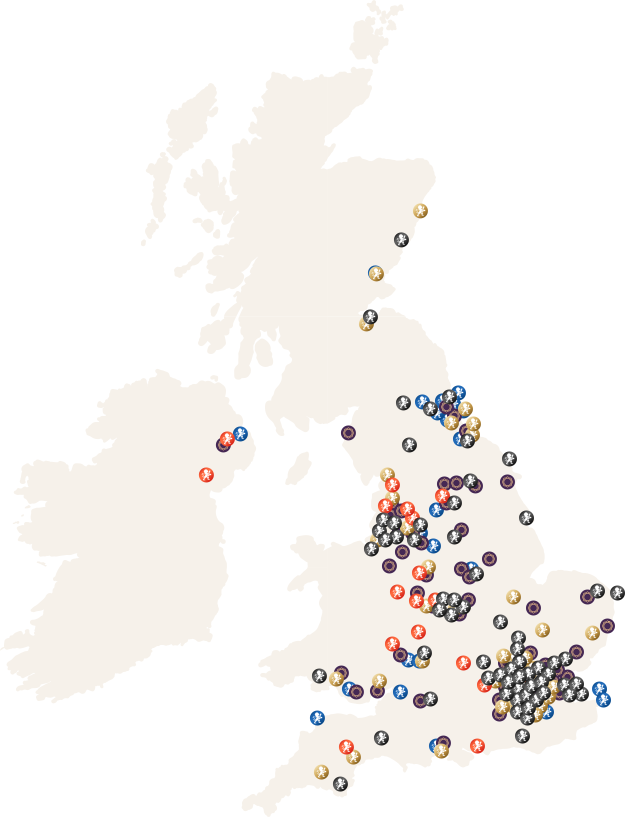
Where our awards and funding reached this year
“The partners we learn most from are those who listen and adapt. I want us to work the same way, being honest about what is not working and being the best we can be to achieve our charitable purpose.”
Map key
- 25 Local Community Skills Fund projects
- 56 Princess Royal Training Award recipients
- 72 bursary recipients
- 17 larger grants and partnerships (including 4 UK-wide)
- 19 Membership Award recipients
Our theory of change
As we develop our strategy, we continue to pursue the outcomes in our Theory of Change, set until FY27, which holds us to account to deliver for the people who need it most, for stronger organisations and a more productive society.
To be a catalyst for opportunity, by removing barriers to getting a job, celebrating best practice and advocating for jobs of the future.
Remove barriers
for people to access opportunities and skills
Learners have access to and achieve skills
Learners feel more equipped and supported, with increased confidence in the future
Learners progress towards, into and sustain work
Support organisations
to offer more opportunities to more people
Best practice is recognised, celebrated and shared with others
Organisations are empowered to leverage additional funding and support
Organisations increase their skills and capacity to deliver
Create wider social change
to enable more people to access skills for work
Critical gaps in provision are identified
Solutions are developed, tested, evidenced and their social return assessed
Systems and sectors have more sustained support for people at risk of exclusion or being overlooked
More people access, develop and apply skills for work, contributing to a more inclusive and adaptable society.
Previous impact reports
City & Guilds Foundation Impact Report 2025


Want to keep in touch?
Keep up to date with Foundation events and sign up for our quarterly newsletter by filling in the form below: